

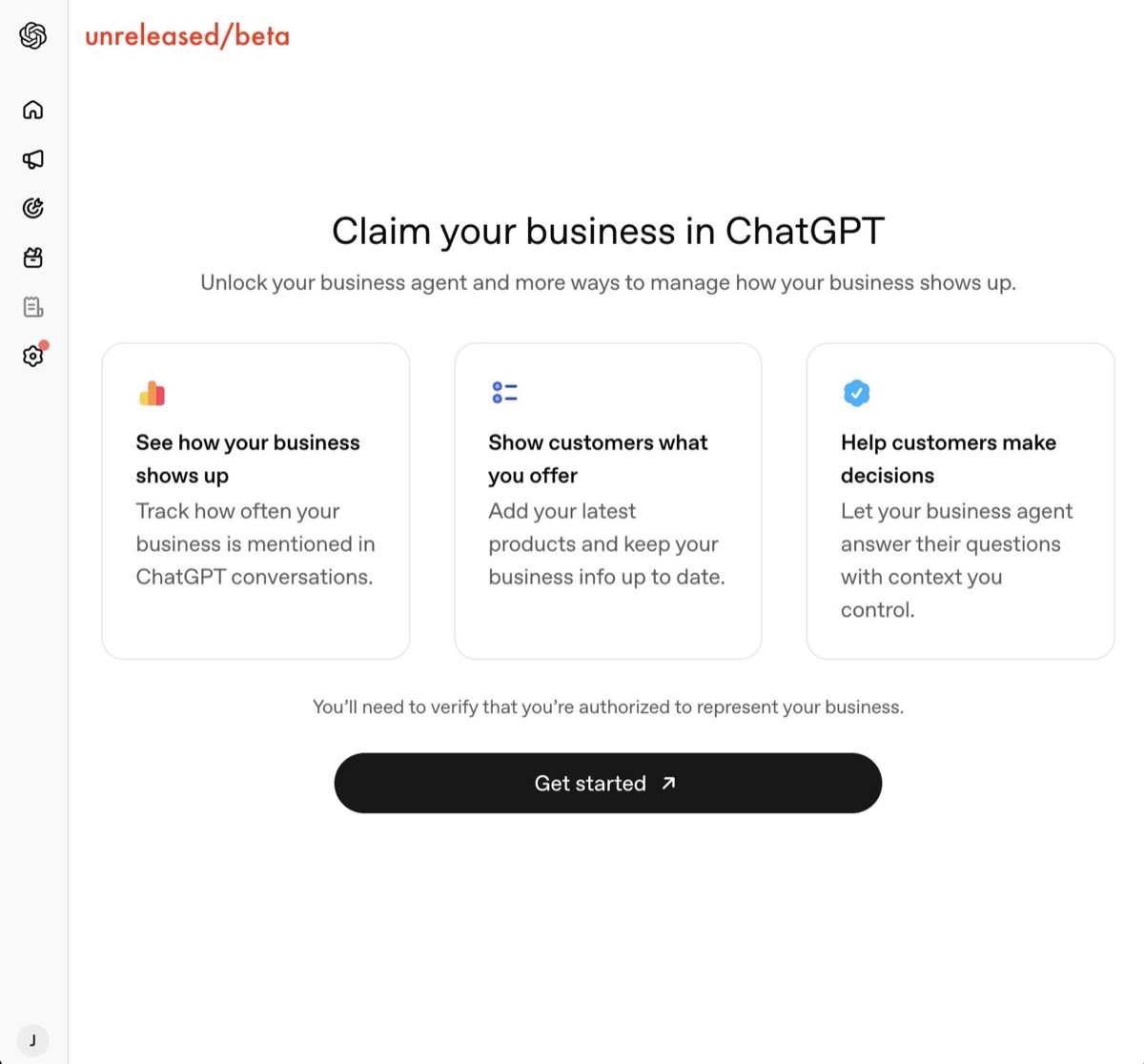
Since November 6, a screenshot with the line "Claim your business in ChatGPT" has been making the rounds. The first how-to guides on listing your business in ChatGPT are already online. But nobody outside OpenAI has actually been able to use the feature yet. So we keep a clear line between what's confirmed, what's reported and our own take.
As of November 10, 2026. We'll update this article once OpenAI launches officially.
Key takeaways
- Not launched: So far, "Claim your business in ChatGPT" is an unreleased beta screen. Juozas Kaziukėnas (Marketplace Pulse) shared it on LinkedIn on November 6, 2026. OpenAI declined to comment to Digiday.
- Reported scope: a "Business Hub" with daily impressions and clicks, a place to manage products and business details, and a "Business Agent" that answers customer questions.
- Shopify first: The only reported way to verify is connecting a Shopify store. If you run your brand on Shopify, this is the part that matters most.
- No proven ranking boost: No source says a claimed profile gets you mentioned more often in ChatGPT. The tool measures visibility. It doesn't create it.
- Still open: launch date, countries (Germany included), pricing and verification without a store.
What happened?
On November 6, 2026, Juozas Kaziukėnas, founder of Marketplace Pulse, posted screenshots of an analytics section inside ChatGPT on LinkedIn. Barry Schwartz covered it on Search Engine Roundtable the same day. The entry point is a banner reading "Claim your business in ChatGPT". According to Kaziukėnas, it's part of a larger "Business Hub". He says he first saw traces of it back in August 2026.
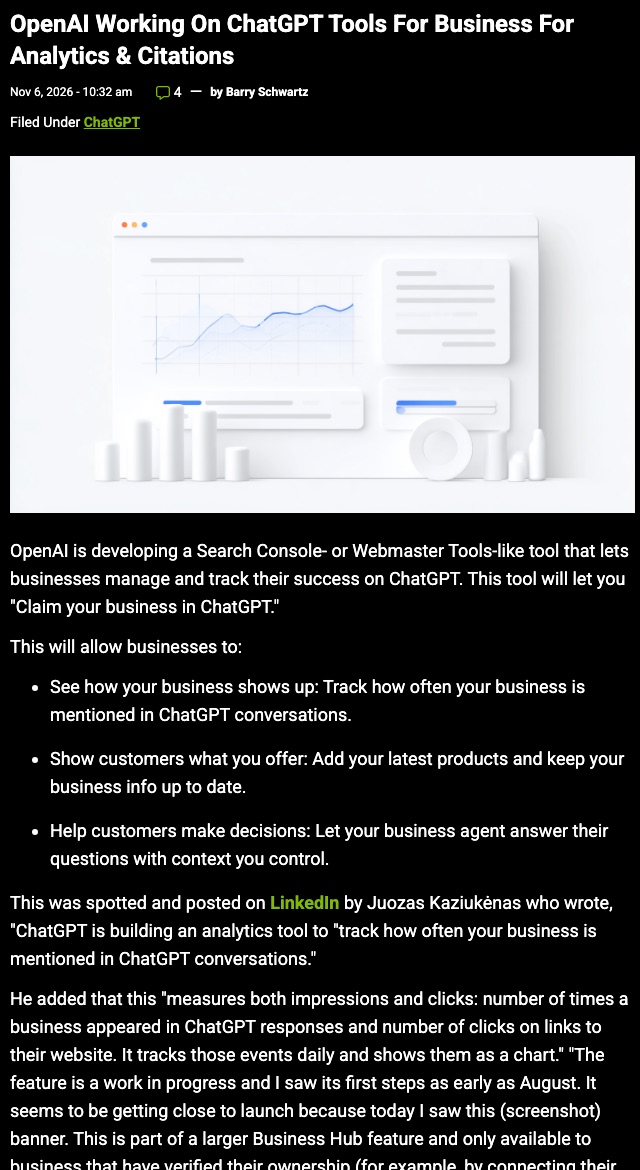
On November 9, 2026, Digiday reported that the Business Hub hasn't launched and has no launch date. OpenAI declined to comment. There's no blog post, no help page and no release notes. "ChatGPT Search Console" is also just an unofficial label coined by the industry.
So the accurate version is: OpenAI appears to be testing a business tool that isn't public yet.
What the Business Hub can reportedly do
Everything in this table comes from the screenshot and from Kaziukėnas' description. OpenAI hasn't confirmed any of it.
| Feature | What's reported |
|---|---|
| Impressions | How often your brand shows up in ChatGPT answers, as a daily chart |
| Clicks | Clicks from ChatGPT to your website |
| Products and data | Add current products, keep business info up to date. Which fields is unknown |
| Business Agent | Answers customer questions using context you provide |
| Verification | Proof that you're authorized to represent the business. Route mentioned: connect a Shopify store |
| Not included | buyer questions, user data, competitors, rankings |
The key point is in the last row. You'd see how often you get mentioned, but not for which buyer questions or why. According to Search Engine Roundtable, the hub targets organic answers and is separate from ChatGPT ads.
Why Shopify brands should pay attention first
Connecting a Shopify store is so far the only concrete verification route mentioned. That fits with what OpenAI has already built for commerce. On chatgpt.com/merchants, merchants submit product feeds for shopping results. Shopify and Etsy merchants are already connected there, everyone else ends up on a waitlist.
For you as a Shopify brand, that means:
- Your product data becomes the source. If you can manage products in the Business Hub, they'll very likely come from your store catalog. Incomplete titles, missing attributes and weak descriptions then go straight into ChatGPT.
- The Business Agent speaks for your brand. What it says about sizes, delivery times, returns or materials depends on the context you give it. Get that right before you switch it on.
- You get your own numbers from OpenAI for the first time. Right now you can only measure ChatGPT through referral traffic and your own buyer question tracking. An impressions chart would be the first number straight from the source.
One comment under Kaziukėnas' post sums up the side effect: if only Shopify merchants get data at first, the first best practices for ChatGPT visibility will form around e-commerce. Measure early and you learn early.
How to get your product data ready for ChatGPT and other AI assistants is covered in our articles on clean product data for Shopify AI shopping agents and on preparing Shopify for AI agents.
Don't mix these up
There are already several official programs around ChatGPT. None of them is "Claim your business":
- chatgpt.com/merchants: product feeds for shopping results via the Agentic Commerce Protocol. According to the page, a self-service area is planned.
- "Get Quote" for local service providers: a beta with selected partners who supply business feeds.
- ChatGPT Ads: paid ads, live in Germany, Austria and Switzerland since August 24, 2026, only on the Free and Go plans.
What's unclear for Germany and Europe
- Availability: No source names any countries. Dr. Web stresses that availability in Germany is unconfirmed.
- Verification without Shopify: Whether brands on other shop systems, B2B companies or local businesses can verify is an open question.
- Pricing and account type: unknown. From everything we know, the hub has nothing to do with the "ChatGPT Business" subscription.
- Data priority: Nobody has looked into whether your details override data from other sources.
- Data protection: No data flows and no GDPR information have been published for the store connection or the Business Agent.
Our take: ChatGPT ads launched in the US in February 2026 and reached 31 European markets, including Germany, on August 24, 2026. A similar sequence, US and e-commerce first, then Europe, is plausible. It isn't confirmed.
Where ChatGPT gets business data today
As long as there's no profile to claim, other sources decide what ChatGPT says about you. They'll likely keep mattering after a launch, too.
What OpenAI confirms: According to its Help Center, ChatGPT rewrites your question into search queries and sends them to search providers. For local info, your approximate location may be shared with "trusted third-party providers". OpenAI doesn't say which ones. It also says a top placement can't be guaranteed.
Everything else we know from studies, mostly from the US:
- Your website: In BrightLocal's Local AI Visibility Study (September 16, 2026, around 200,000 local buyer questions), business websites account for 42% of all source mentions.
- Yelp: According to Axios (July 23, 2026), Yelp has a licensing deal with OpenAI. Steady Demand (August 2026, 2,880 buyer questions) found Yelp behind the business cards in 95.83% of runs.
- Google, indirectly: Peec (Tomek Rudzki, September 2026) inferred at least eight external providers from ChatGPT's server data, likely including a scraping service for Google Search and Google Maps. That's Peec's inference, not a statement from OpenAI.
- Foursquare: The often-quoted figure "60 to 70% of the data comes from Foursquare" is based on 50 buyer questions in five Spanish cities (May 2025). Steady Demand found Foursquare in 0.00% of visible source mentions.
The same BrightLocal study shows how volatile the results are. Between repeated runs of the same question, only 23% of the businesses mentioned overlap. There's no stable "#1 in ChatGPT". That's why you measure visibility across many questions and several runs, not with a single screenshot.
This matters most for local businesses, because ChatGPT shows them as cards with address and reviews.
How big is the channel today? According to SE Ranking (July 13, 2026, 101,574 websites), ChatGPT's share of traffic in Germany was 0.28% in May 2026, the highest so far. At the same time, according to Bitkom (reported by t3n, July 12, 2026), 41% of AI users say they turn to tools like ChatGPT first when they have a question. Lots of recommendations end without a measurable click. That's exactly the gap an impressions dashboard is meant to close.
What the industry is saying
The reactions come from the SEO, GEO and e-commerce crowd. None of them has used the feature themselves.
In favor:
- Lily Ray shared the screenshots on X and asked whether this is the first version of a ChatGPT Search Console.
- Aleyda Solis called the move long overdue on X.
- Juozas Kaziukėnas sees the value in using OpenAI's own numbers to prove whether GEO work pays off. But without buyer question data, he says, the tool can't explain why mentions change.
Voices from Germany:
- Matthäus Michalik argues on OnlineMarketing.de that this makes buyer question tracking more important. Without buyer questions, you don't know where the impressions come from.
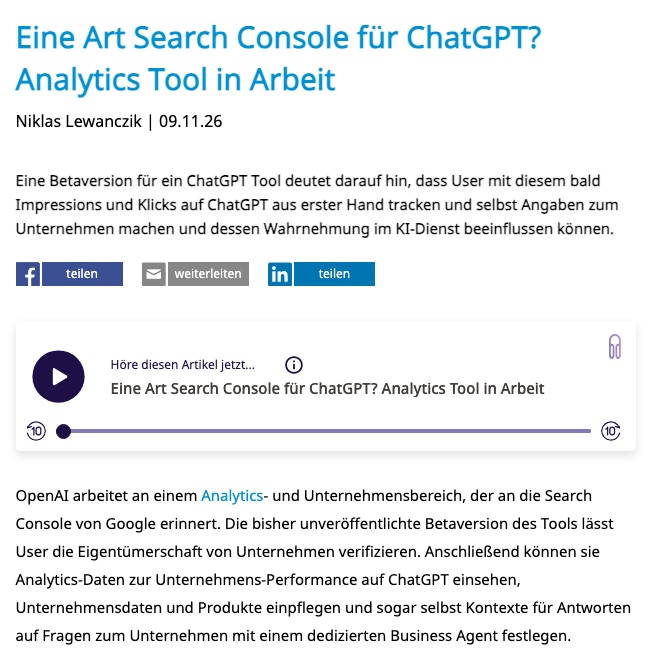
- Niklas Lewanczik (OnlineMarketing.de) compares the data side to Google Business Profile, but thinks the numbers are of limited value without buyer questions and competitors.
- Dr. Web points to the Google Search Console bug that inflated impressions from May 2025 to April 2026. New metrics deserve healthy skepticism.
- Martin Grahl (Claneo) asked his LinkedIn network who would claim their business as soon as it's possible.
Skeptics:
- Terry Van Horne calls the metrics vanity numbers in the comments.
- One comment raises the methodology question: rising mentions could simply come from ChatGPT's user growth.
- Adam Hafez suggests checking the clicks in the tool against chatgpt.com sessions in your own analytics. A big gap points to lost tracking.
- Digiday sees the free dashboard as a funnel into ChatGPT ads, much like Search Console is for Google Ads. According to Digiday, OpenAI reported more than 100,000 advertisers at the end of October.
Checklist: what you should do now
Sorted by strength of evidence. The first items pay off even if the Business Hub never comes to Germany or the rest of Europe.
| Priority | Action | Evidence |
|---|---|---|
| 1 | Make your website and product pages crawlable and specific: clear product and service pages, prices, shipping, returns, FAQ. Don't block OAI-SearchBot in robots.txt. | proven: websites are 42% of AI source mentions (BrightLocal) |
| 2 | Keep your product catalog clean: complete titles, attributes, variants, descriptions. On Shopify, this is the likely data source for the hub. | strong for shopping results |
| 3 | Sort out access: Who controls the domain, the Shopify admin, the Google profile? Check what data a store connection would share. | preparation: verification requires authority to represent the business |
| 4 | Track ChatGPT as its own channel in GA4. | preparation: baseline for checking against hub clicks |
| 5 | Measure visibility across many buyer questions, monthly, several runs per question, competitors included. | methodologically proven: only 23% overlap between runs |
| 6 | Build external proof: reviews, mentions in trade media, comparison and best-of lists. | expert consensus |
| 7 | Local: Keep your Google Business Profile complete, maintain your Yelp listing. | indirectly proven, untested for Germany |
| 8 | Claim your ChatGPT profile as soon as it's available in your market. | benefit: correct data and your own numbers, no proven ranking effect |
| – | llms.txt as a lever, focusing on Foursquare, paid "ChatGPT listing services" | hype: no evidence, there's no official process yet |
How we can help
We check whether ChatGPT, Perplexity, Claude and Google mention your brand for buying questions, which sources back up the answers and what proof you're missing. Then we build that proof. For Shopify brands, we work directly on the catalog, with Shopify GEO or our Shopify app SPHEN.AI.
Want to know where you stand today? Talk to us.
Sources
- Search Engine Roundtable, Barry Schwartz: OpenAI Working On ChatGPT Tools For Business, November 6, 2026
- Digiday: ChatGPT is about to show brands their mention count, November 9, 2026
- Juozas Kaziukėnas on LinkedIn: Post with comments, November 6, 2026
- OnlineMarketing.de, Niklas Lewanczik: A kind of Search Console for ChatGPT? (German), November 9, 2026
- Dr. Web: ChatGPT Search Console / Business Hub (German), November 7, 2026
- OpenAI Help Center: ChatGPT search
- OpenAI: chatgpt.com/merchants, accessed November 9, 2026
- OnlineMarketing.de: OpenAI launches ChatGPT ads in Germany (German), August 2026
- Axios: Yelp reviews in ChatGPT, July 23, 2026
- BrightLocal: Local AI Visibility Study, September 16, 2026
- Steady Demand: Study on ChatGPT data sources, August 2026
- Peec, Tomek Rudzki: ChatGPT search result providers, September 2026
- SE Ranking: ChatGPT referral traffic, May 2026 (German), July 13, 2026
- t3n on the Bitkom survey: AI use in Germany (German), July 12, 2026